Sunday, March 17, 2013

Thank God for science.

Two days ago, I had the unfortunate experience of eating a bite of stone pot-cooked rice at a Japanese-style cafe in Hong Kong, and immediately feeling sick afterwards, which I later on found out was due to the peanut sauce mixed into the rice. Oh, allow me to clarify: I am deathly allergic to any kind of nut, and peanuts most of all.

I'm sorry to say that, as careful as I have been in eating due to my numerous food allergies (mainly being nuts and various seafood), I've had a few experiences where I ended up in the hospital from eating something I would not have expected to have peanuts in it. This most recent incident was my second time going to the emergency in Hong Kong because of this, and I also had a similar sitaution in Macau almost two years ago.

I've had many different hospital experiences in my life, some when I went to the hospital for myself, other times for my mom. I've been to the emergency in Richmond when my mom slipped and hit her head when she was sick, and I've been to the palliative care ward in a hospital in Vancouver, when she was staying there before she passed away. I frequented the Children's Hospital in Vancouver for multiple surgeries when I was little, went to a hospital in Montreal when I dislocated my shoulder a few years back, went to a private hospital in Hong Kong last year for dermatology-related surgeries, and to public hospitals in Hong Kong for my allergy emergencies.

All in all, I've had my fair share of hospital experiences. I wouldn't call myself an expert at all in medicare, but in any case, I think I have a decent range of experiences--maybe enough to make a few comparisons from personal history.

Firstly, something I was really pleased about was that an ambulance ride in Hong Kong is an included service in the medical care.

Shortly after we called for the ambulance two days ago, three men carrying enormous backpacks and bright red blankets came into the cafe. Two of them were young, in their twenties, and one was middle-aged. They all wore flu masks. They unloaded some basic equipment from their packs and attached some of them onto me to check my vitals, and asked me some basic questions on what kind of pain I felt. Mainly, their primary concern was to make sure I wasn't having any trouble breathing.

I mentioned I felt like I was about to puke, and was given a plastic bag to loop around my neck which came in very useful later on. They fixed an oxygen mask on my face that I believe was connected to a portable oxygen machine later on attached to the side of the stretcher, and told me if I wanted to puke at any time, to simply remove the mask and do my business. More men brought in the stretcher and lowered it for me to climb on; then they wrapped me in a blanket, and the six of them and I (on the stretcher) proceeded to the side of the mall where we rode a staff elevator down to the ground floor to meet the ambulance parked on the side of the road outside. Not that one usually cares when they're fighting major chest pain and in the middle of a race to the hospital, but I must say I was feeling pretty important with so many people waiting on me!

They checked my vitals again nearing the end of the ambulance ride, and I was wheeled into the emergency ward when we arrived at the hospital. I wasn't exactly alert enough to be taking my time in looking around, but I could hear that there were a lot of people sitting in the emergency waiting area. They wheeled a hospital stretcher beside mine and four men, each holding a corner of the blanket I was on, hauled me onto the other stretcher on the count of three, and switched the blanket that was covering me. I was a little sad to see the ambulance men go; I think I preferred them over the hospital staff as they seemed a little friendlier and patient (or as friendly medical people/people in Hong Kong can get).

The rest of my afternoon at the hospital was generally the same as all my other experiences at hospital emergency wards. They take a look at my vitals multiple times, pester me to the point of slight annoyance about my basic information (name, address, etc.), and ask how exactly I ended up in this condition. It doesn't become annoying until about the fifth time I have to repeat the same information with an incredibly sore throat and in a barely audible voice thanks to all the puking.

The colour of the blanket wrapped around me while in the ambulance. The colour of security.

The good thing about being hospitalized in Hong Kong is that medical care here is relatively inexpensive, at least for Hong Kong residents such as myself. The ambulance service, immediate medical attention at the hospital, medication via injection, about an hour of rest afterwards in a curtained area, and medication to take home--all of this costed me just $100 HKD (about $13 CAD).

This compared to what I would have sacrificed to take an ambulance in Montreal, Canada, had any of them actually arrived, points out some big differences.

First of all, in the case where I dislocated my shoulder in Montreal, I would have had to pay over $50 CAD just for them to pick me up and drive up the slope. My dad remembers paying the same amount in Vancouver when my mom was transported to the hospital in an ambulance. When I dislocated my shoulder (this was about five years ago), I had to trudge across my university campus to reach the first aid room. There they called the ambulance to take me to the hospital which, in fact, was located just at the top of the hill we were already on. A maximum three minute ride. The first one never came, and when someone called again for the ambulance about 45 minutes later, the coordinator had told them that she didn't know what happened with the first ambulance, but that she'll send another one regardless. That one never came either. Fortunately I only had a dislocated shoulder; although I was in enough pain to almost pass out, it was bearable. But if someone else had been me and needed more immediate medical attention, I'm pretty sure they would have died waiting for an ambulance.

I ended up calling and taking a taxi that time, by the way. The taxi driver was understanding enough to agree to the short drive.

That being said, I do think that staff in hospitals are generally friendlier in Canada and treat patients less like a business transaction. Cultural attitudes might play a role in this difference, but then again, not so much, I think. Public hospitals are always overflowing with people at the emergency in Hong Kong, and obviously you can imagine this would create quite the din in the waiting area. But it's not just the patients awaiting medical assistance, it's the staff that's loud too. You have to understand that, as a patient under pain and submitted to extended periods of time lying on a stretcher, you hear more than you see. They should really enforce that no-phones rule at hospitals. There's something very disrupting at having loud ringtones jump out at you; I remember the same, darned ringtone when I was on the stretcher two days ago, blasting within my range of hearing at least five times within an hour. I was also able to gather a lot of unnecessary information on how sick one particular colleague at the hospital was. I heard snippets of other patients' information being loudly called out between the staff. The man who helped me onto one of the stretchers picked up a call and the conversation over that call had clearly been a personal matter.

This was the emergency ward, of course, and would make a poor representation of the hospital overall. But the last time I was at this particular hospital for the same reason, it was in the middle of the night and I had been admitted to one night at the hospital so I could be under their observation. But I ended up forcefully discharging myself from the hospital, because upon being wheeled into a room on another floor that I was supposed to stay in for the night, I suddenly had an inexplicable fear of that place. It was dark, cold, and empty with beds too close in proximity with one another. No visitors were allowed to be with patients after a certain time at night, so I would have had to stay in that cold space alone for the entire night, and the staff seemed either absent or generally unsparing in their attitudes. I felt like a human experiment. So I had refused to stay. I was still charged for a night at the hospital because "all the paperwork had been done" already, but fortunately, it was inexpensive and I just took my medication and left (to my great relief).

Staff in palliative care in the Canadian hospital my mom was at were very kind. Maybe because my mom had a more serious or complicated case and was in a much graver situation, but there were many doctors who personally came in to see her and talked to and about her to me as if she was truly under their responsibility. I was very grateful for that. Most nurses were very pleasant and treated even family members like myself as people--people who were also suffering at that. Even at the emergency in Montreal when I finally did get looked at by a doctor, at least I felt like I was treated like a human being by the doctor. Maybe it was just that I was assigned a doctor who had a smile for me even when he probably had a long day already. Although, to be honest, other personnel at the hospital were less caring and I did end up waiting over three hours at the emergency, hunched over for hours waiting for them to fix my dislocated shoulder. The shoulder, in fact, relocated itself after three hours of waiting, and by the time they took me in to look at it, it had already been fixed on its own and they didn't have to do anything other than take an x-ray.

Well, the bottom line is, there are both extremely good aspects and extremely bad ones in all the medical care I've received or witnessed in both Canada and Hong Kong. The medical community is an extremely stressful and sensitive place; I most certainly am not attributing any blame for its uglier parts to anybody working in the field. I am most grateful for all the individuals who decided to dedicate their lives to working in such a stress-inducing but necessary space, and I am looking forward to even further improvements to be made in the future, for all the people who are in need in this world.

I'm so glad to be alive, and I'm sure that every person who has received medical help in the past feel the same. Thank God for science!

Saturday, February 23, 2013

"Chewy" seems to be the recent theme.

Some nights ago, I volunteered to make dinner and tried making gnocchi from scratch. Why gnocchi? To be honest, it was completely random. There was a copy of the Metro newspaper lying in my kitchen a few weeks ago, and while carelessly flipping through it, I came across this short recipe for "Annie's Gnocchi". I figured, why not? and cut the clip out.

 So I finally got around to putting the recipe to use this week. I actually had no idea what gnocchi tastes like; I've never had it, and I wasn't particularly interested in having it either (carbs...). But the idea of making your own pasta from scratch seemed kind of fun, so just decided to try it out.

There's also the fact that I don't particularly like cooking. For baking, you measure and mix and knead, along with all the other stuff, in one short but productive session. Then you stick it in the oven and come back in however many minutes.

What I don't like about cooking is stuff like, Simmer for 1 to 1 1/2 hours and stir occasionally. Which is what I did for the tomato meat sauce. It's annoying! Simmering for an hour and a half means you have to stand near the stove, for an hour and a half, so you can stir it every few minutes. What can you do in between those few minutes? Nothing! I tried to read while standing next to the stove, but I still don't like having to stop and look up from where I'm reading every few minutes, it disrupts my reading experience.

Something else about cooking is that it's not precise like baking. Yes, I'm one of those people. If I'm going to read instructions, I want them to be specific. But I guess cooking itself mostly comes from experience and intuition, rather than memorizing measurements and reading recipes.

After skimming the recipe, I basically realized that I didn't really need the recipe at all. Like how I just kept adding flour because I felt the potato dough wasn't firm enough to be kneaded, or the tomato sauce wasn't thick enough so I added more beef and let it cook longer... or how the potatoes took nearly an hour to soften under boiling water.

In any case, with additional broccoli on the side (veggies, my favourite part of any meal!), the gnocchi dish did, in fact, end up tasting quite good. I assume gnocchi is supposed to taste similar to any other sort of pasta-like dish--soft and slightly chewy. Sounds like success to me?

Because the potatoes took so long to soften so I could mash them, we ended up having dinner a little later than usual. I felt bad for making my grandparents wait, but... well, authenticity aside, now I can say that I've had gnocchi before!

A few days after my attempt at gnocchi, I wanted to use up the remainder of red bean paste and rice flour, so I tried crafting them into (pseudo) daifuku. I can't say it looked very pleasing to the eye, and it was chewier than I would have wanted it to be, but still edible for the most part. Oh well, irrelevant to me! I don't eat much of what I make myself, so I'm not the one taking the risks. Hah!

Monday, February 18, 2013

Glutinous rice flour, where have you been all my life?!

These past few days have been sunnier than the prior half of the week, which in turn put me in higher spirits. I still spent most of my time indoors, but it's just nice to wake up and see sunshine streaming in through the windows and the house brightly lit throughout the day. I've even made an effort to go out for short walks.

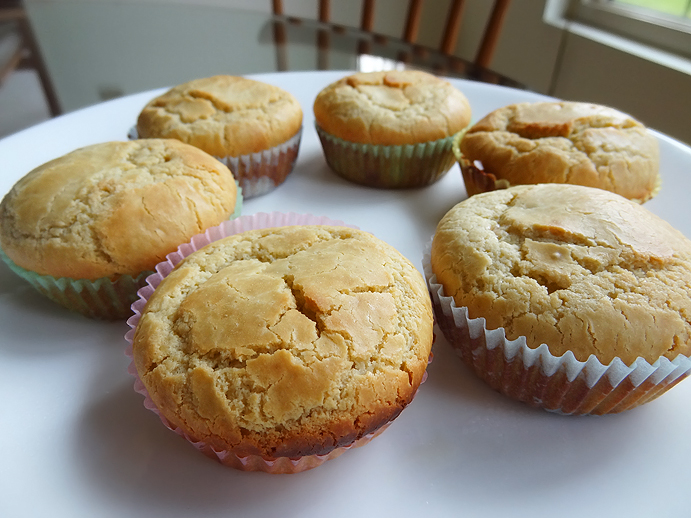
To top it off, yesterday, I successfully made red bean-filled mochi cupcakes! It's quite easy; basically use glutinous rice flour for the batter, and it gives a wonderfully chewy yet still cake-like texture. I used store-bought canned azuki beans for the filling, but I think next time I'm going to try to make the filling myself. I was too lazy to try this time around because, to prepare the red bean paste, the red beans need to soak for at least a couple of hours. But I also found the canned paste to be a bit too sweet for my liking, so in the end, it's probably better if I make it from scratch next time and adjust it to my own liking.

I actually did mix a bit of matcha powder into the batter, but I think I'll need to invest in some higher quality matcha for my next try, because it really didn't seem to have made much of a difference in the colour or the taste for yesterday's batch.

Nonetheless, I'm very happy with the result! The tops cracked nicely and the insides were not too moist, just the right amount of fluffiness. I'm glad I didn't put too much filling inside each one since the paste is quite sweet, but good in small doses.

At first I used standard-sized paper cups, but I tried using smaller ones for the second round and I think those were just the right size. Plus, some colour always makes things more fun. Yes, aesthetics matter very much in the overall dining experience!

Even my grandparents agreed that they were a success (yay!). We had a guest over for dinner last night, and we ended up giving her some cupcakes to take home after she commented on how delicious they were. I also took some to a friend's house in the evening, and came back with an empty container. Fattening up my friends is one of my favourite activities.

I'd recommend anyone to try making these, they really are easy to make and not time consuming at all. And it's always nice to experience that pleasant surprise, when you try something a little different and it actually works!

Friday, February 15, 2013

A slice of cake is all you need.

Well, there goes another Valentine's Day! A bit of a rainy one this year in Vancouver.

To be honest, this year I spent considerably less effort than I did last year when I made the painstaking Hello Kitty truffles. But to keep up with my annual chocolate tradition, I did try a chocolate cake recipe from the Ladurée recipe book for sweets that I received for Christmas from a dear friend of mine. I had been deathly sick with a stomach flu from Christmas Eve all the way through until New Years, so when I received this in the mail (via another friend) on New Years Eve, I was ecstatic.

The book is beautiful! Velvet cover, gold edges, and pretty pictures inside. So far, I've only tried two recipes from the book. Two out of the few recipes that don't take 4 to 24 hours of preparation. I don't think either of my attempts quite turned out the way that they were supposed to; regardless, they tasted all right.

For this year's Valentine's Day, I decided to try the soft chocolate cake.


Basically, it was a lot of double boiling, pouring and repouring mixtures, and eggs. The cake wasn't as professional or successful as I would have hoped, so I decided to top each slice with a ganache I made afterwards. For the ganache, I included coffee and orange zest. It actually made a pretty suitable topping for the cake.


Happy Valentine's Day! Hope you had a day filled with chocolatey goodness. Oh, look at that. "Chocolatey" didn't result in a red squiggly line appearing under it. Excellent dictionary.

Saturday, February 9, 2013

A little early, but Happy Chinese New Year!

Since it is almost Chinese New Year, I decided to dedicate the efforts of my next baking venture towards a Chinese-style dessert. And on a whim, I tried making Hong Kong style egg tarts, or better known as "dan tat" (蛋撻). 


Egg tarts have been a staple in bakeries and coffee shops in Hong Kong since the beginning of time (and as far as I'm concerned, that's sometime before I was born). I tend to shrink away from making Chinese pastries or desserts, probably because I had them so often while growing up, that I would see it as a failure if the ones I made didn't taste exactly like the ones I would find in stores.

That, and also the fact that my grandparents are super critical of food, and the products of my baking experiments are not an exception. Certainly my grandparents would tell me if they thought any of my baked goods tasted passable or even good, but it is always followed by a word of constructive criticism, or sometimes they would simply comment with "it is too _____" or "it could be more _____" and leave it up to me to decipher their implications on what they generally thought of it.

While I don't mind most of the time--and it is helpful for an aspiring baker such as myself, of course--I also feel that they may be extra critical if I try making something familiar to them (ie. Chinese cuisine) as opposed to making something they would have never tried before, and sometimes I just don't feel up to the task yet.

Nevertheless, I decided to try my hand at the egg tarts. Instead of using tin foil cups (I did say I tried this on a whim), I used the silicone cupcake molds I received for my birthday last year. Other than the fact that I seemed to have made the crust a tad too thick, and that the bottoms of some of them were slightly burnt, the egg tarts turned out quite nicely!

I might adjust the recipe next time for the benefit of my grandma, who has diabetes, and maybe actually use foil cups.

Although I didn't exactly get a stamp of approval from my grandparents this time, perhaps I will attempt more Chinese pastries in the near future. It was actually kind of fun. Here's an early Happy Chinese New Year from me!